
“Be greedy when others are fearful.”
“Buy when there’s blood in the streets.”
“Think for yourself.”
You’ve heard those ideas before.
And sometimes they’re useful.
But there’s a big difference between buying a stock that’s temporarily misunderstood…
And buying one that’s falling for very good reasons.
But here’s the uncomfortable truth almost no one talks about:
Most investors are forced to make decisions from the outside looking in.
Let me tell you about a technique that helps separate meaningful buying signals from ordinary market noise.
Dear Fellow Investor,
Contrarian investing sounds simple but in practice, it’s incredibly hard.
How do you really know when fear has gone too far?
How do you know whether a stock is temporarily beaten down or permanently broken?
How do you tell the difference between:
- A great company going through a rough patch, and
- A company whose best days are behind it
The truth is most investors don’t know.
So they guess.
They look at a chart. “This looks oversold.”
They read the headlines. “Sentiment feels too negative.”
They notice a sector is out of favor. “This must be the bottom.”
But those aren’t signals. They’re interpretations.
And that’s why so many bargain-hunting trades end in frustration.
You buy a stock after it falls 30% only to watch it fall another 30%.
You step into a sector everyone hates only to discover there were very good reasons people were selling.
You convince yourself you’re being bold and contrarian when in reality, you’re just too early.
Or worse—wrong.
If you’ve ever experienced that sinking feeling…
Buying what looked like a bargain only to watch it keep dropping…
You’re not alone.
It happens all the time.
Because the core problem with traditional contrarian investing is this:
There’s no reliable way to know when fear has actually gone too far.
No clear signal. No confirmation. No verification.
Just a feeling… a judgment… a guess.
Meanwhile, something very different is happening. Quietly. Behind the scenes.
Because while most investors are trying to interpret the market…
The people running the companies already know what’s really going on.
They don’t rely on headlines.
They don’t need to read analyst reports.
They don’t guess based on price charts or sentiment indicators.
They see the business in real time.
They know whether orders are holding up…
Whether customers are sticking around…
Whether margins are stabilizing… or still under pressure.
In other words they live in reality while the market trades on perception.
And when that gap between perception and reality gets wide enough…
They don’t make predictions. They take action.
They reach into their own pockets and start buying shares of their own company.
Not with options.
Not with bonuses.
Not with abstract compensation packages.
With their own personal cash.
At the exact moment when the headlines are negative. The stock is under pressure. And most investors are heading for the exits.
This is one of the most powerful and overlooked signals in the market.
Insiders don’t buy for entertainment.
They don’t buy because something “feels cheap.”
And they certainly don’t buy because they enjoy watching their own money go down.
They buy because they believe the market is wrong.
In fact, research and real-world experience show something even more interesting.
When insiders buy aggressively, especially in clusters, it often happens during periods of market weakness.
During pullbacks.
During corrections.
During moments when fear is elevated.
Insiders tend to “step in to do some surgical buying” when selling pressure becomes intense.
In other words they don’t guess at bottoms.
They recognize when prices have drifted too far from reality—and they act.
And here’s where things get really interesting.
These insider purchases don’t happen after the recovery begins.
They happen before.
Weeks before. Sometimes months before.
Long before the headlines change…
Long before analysts upgrade the stock…
Long before the crowd starts to feel comfortable again.
This creates what you might call a hidden window in the market.
A gap between when insiders act and when the rest of the market catches on.
During that window prices are still depressed, sentiment is still negative, and opportunity is still wide open.
But most investors never see it.
Insider buying doesn’t show up on CNBC, The Wall Street Journal, or Investors Daily.
It doesn’t trend on social media.
It doesn’t come with flashing headlines.
It shows up in regulatory filings, quiet disclosures, small data points that, on their own, don’t look like much.
Unless you know exactly what to look for.
AND, how to separate meaningful signals from noise.
Because not all insider buying matters.
Some purchases are small. Some are routine. Some are meaningless.
But others are different.
Large, intentional purchases.
Multiple executives buying at once.
Repeated buying during weakness.
These are the kinds of signals that have, time and again, preceded major moves.
One CEO stepped in with a $1 million purchase following a sharp pullback, a classic high-conviction signal tied to future outperformance.
In another example, insiders across an entire troubled sector were putting millions of dollars to work despite overwhelmingly negative headlines, signaling that bad news was already priced in.
These are not guesses. They are actions.
And that’s what makes all the difference.
Once you shift your perspective from trying to interpret the market to observing what insiders actually do … everything changes.
It’s no longer a question of “Does this stock feel cheap?”
Now it becomes “Are the people who know this business best buying it right now?”
That question is far more powerful.
Because it transforms contrarian investing from something subjective and uncertain into something grounded, observable and repeatable.
This is what we call … the Contrarian Upgrade.
A way to move beyond gut feelings and hunches and instead rely on a form of built-in verification: real-money decisions made by the people closest to the truth.
While that insider data is technically public it’s not easy to use.
The raw information is messy. It’s scattered across filings. And it’s filled with noise.
Without a clear framework, it’s almost impossible to tell which signals matter and which don’t.
That’s why most investors ignore it.
Or worse they misuse it, focusing on the wrong transactions.
They misread the signals. They jump in too early, or too late.
Which is why simply knowing that insiders are buying isn’t enough.
You need a way to:
- Track it.
- Filter it.
- Interpret it.
- Act on it—at the right time.
And that’s exactly what you’re about to discover.
A disciplined, time-tested approach designed to help you identify the most meaningful insider buying signals.
Especially in stocks that are out of favor.
At the exact moment when fear and mispricing create opportunity.
In short, way to practice contrarian investing with verification instead of guesswork.
If you step back and look at how most investors try to “be contrarian,” a pattern quickly emerges.
It’s not really a system. It’s a series of judgments.
“This stock looks cheap.”
“This sector feels washed out.”
“Sentiment can’t get much worse.”
Sometimes those judgments are right.
But just as often they’re early. Or incomplete.
Or based on surface-level information that misses what’s actually happening inside the business.
The fundamental weakness of traditional contrarian investing is it’s subjective.
It relies on your interpretation of price action, headlines, and sentiment. No matter how experienced you are those inputs are, at best, indirect. They tell you what people think is happening. Not what’s actually happening.
That’s why two investors can look at the exact same situation, the same stock, the same chart, or the same news and come to completely different conclusions.
One sees opportunity. The other sees risk.
Both believe they’re being contrarian.
But at most only one is right.
Now compare that to a very different kind of signal.
A signal that doesn’t come from opinions, or sentiment surveys, or price patterns.
A signal that comes from real actions.
Specifically, the actions of the people running the company.
When a CEO buys $1 million worth of stock…
When multiple directors step in during a selloff…
When insiders return again and again to accumulate shares during weakness…
That’s not interpretation. That’s not theory. That’s evidence.
And it’s evidence rooted in something far more powerful than external observation.
It’s rooted in inside knowledge of the business itself.
Because insiders operate from a completely different vantage point than the rest of the market.
They’re not trying to piece together a picture from quarterly reports, media coverage, or analyst notes.
They’re living inside the business every day. They see the order flow. They understand customer behavior in real time. They know whether a slowdown is temporary or structural.
They see early signs of improvement long before those changes show up in the numbers the public relies on.
They have operational visibility that no outside investor can match.
That creates an enormous informational advantage.
Not in the sense of illegal insider trading but in the sense of context. Perspective. Understanding.
They know when conditions are stabilizing even if the headlines are still negative.
They know when a problem is manageable even if the market assumes it’s catastrophic.
They know when the market is overreacting.
When that happens they don’t publish a report or issue a bold forecast. They act.
They commit capital. Their own capital.
This is a critical distinction because it means insider buying is not just a signal of information. It’s a signal of conviction.
Anyone can say a stock looks attractive.
Very few people are willing to write a large personal check to prove it.
When you begin to focus on those actions instead of trying to interpret the market from the outside you start to see something that most investors completely miss.
A pattern.
A sequence that repeats itself over and over again. Across industries. Across market cycles. Across very different economic environments.
It typically looks like this:
First, a stock declines. Sometimes gradually. Sometimes sharply.
The reasons vary—earnings misses, sector rotations, macro concerns, negative headlines.
But the result is the same: the stock falls and confidence erodes.
Next comes the second phase: Panic—or at least neglect.
Investors lose interest. Analysts turn cautious. Media coverage fades or becomes negative. Funds rotate into “better-looking” opportunities.
At this stage, the story around the stock is almost always one-sided. There are far more sellers than buyers. Prices often drift below what the underlying business justifies.
This is where traditional contrarian investors step in. Or at least where they try to.
They look at the decline. They sense the negativity. They assume the pendulum has swung too far.
And sometimes, they’re right.
But often they’re stepping in without confirmation. Without validation. Without knowing whether the situation is stabilizing—or still deteriorating.
Now comes the third phase. The one that changes everything. Insider buying begins.
Not always immediately. Not always dramatically. But often in a way that stands out—if you know what to look for.
A director makes a sizable purchase. A CEO steps in with a meaningful buy. Then another insider joins.
Sometimes it becomes a cluster. Sometimes it’s repeated buying on weakness.
And importantly this activity tends to happen while the news is still negative.
While sentiment is still cautious. While the stock is still under pressure.
Insiders often step in specifically when selling pressure becomes intense, taking advantage of temporary dislocations rather than waiting for clarity.
This is not a coincidence.
It’s a reflection of how insiders think.
They’re not waiting for confirmation from the market.
They’re acting on what they already know about the business.
And, this is your window of opportunity for optimal profit.
Then comes the fourth phase: stabilization.
The selling begins to slow. The stock finds a floor.
Volatility may remain—but the relentless downward pressure starts to ease.
And finally the fifth phase: recovery.
The narrative begins to shift. Analysts become less negative.
Investors start to reconsider. New buyers step in.
And the stock begins to move higher—sometimes gradually, sometimes quickly.
By the time this phase is obvious the biggest opportunity has often already passed. The most attractive entry point was back in that earlier window. When the stock was down, sentiment was weak. And insiders were buying!
This pattern—decline, panic, insider accumulation, stabilization, recovery—is not rare.
It’s not isolated. It’s not dependent on a specific sector or market condition.
It shows up in:
- Defensive stocks during economic uncertainty
- Cyclical names during temporary slowdowns
- Growth companies after earnings disappointments
- Entire sectors facing negative headlines
For example, even in heavily criticized areas like private credit, insiders have stepped in with millions of dollars in purchases across multiple companies, signaling that the worst fears may already be priced in.
Different context. Same pattern.
Which brings us to the most important point.
This is not about predicting the future.
It’s about recognizing when probabilities begin to shift.
When perception has drifted too far from reality.
And when the people closest to that reality are quietly signaling their confidence.
And here’s where it becomes powerful for you.
Because you don’t need to be an insider to benefit from this dynamic.
You don’t need access to private information.
You don’t need to sit in boardrooms or earnings calls.
All of this activity is disclosed. Trackable. Observable.
The key is knowing how to interpret it correctly.
And once you do you can begin to do something very few investors ever manage to do consistently:
Align yourself with the people who know the business best.
At the exact moment when the market is most uncertain.
Instead of guessing when fear has gone too far you can look for confirmation.
Instead of relying on instinct you can rely on evidence.
Instead of trying to outsmart the crowd you can follow the actions of those who already understand what’s really happening.
And that is the essence of the shift. You go from guessing to knowing.
To really understand why this approach works you have to understand when it works.
Because the opportunity here is not just about what insiders do.
It’s about when they do it—relative to everyone else.
And once you see that clearly you can recognize a powerful and persistent inefficiency in the market.
Here’s the key insight.
By the time the opportunity feels obvious… the best part of the move is often already underway.
Because the earliest and often most attractive entry point is phase 3.
That’s when the stock had already declined and sentiment was still negative and insiders were quietly accumulating shares.
That gap between those two moments is where the opportunity lives.
That’s the Window of Opportunity.
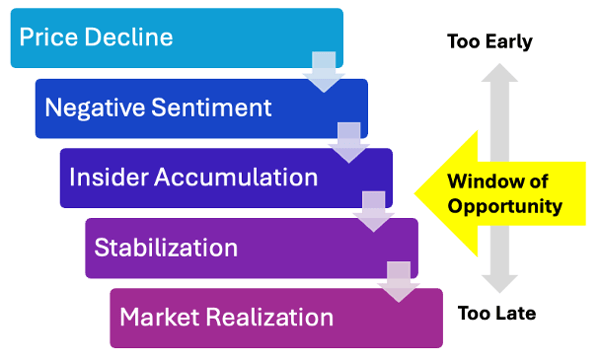
During this window:
- Prices are still depressed
- Sentiment is still cautious
- And uncertainty is still high
That is exactly why the opportunity exists – most investors are wired to avoid uncertainty.
They want confirmation. They want clarity. They want reassurance that the worst is over.
But markets don’t reward certainty.
They reward correct positioning ahead of certainty.
That’s what insiders are doing.
They are positioning themselves before the narrative shifts.
Before the data confirms improvement.
Before the crowd returns.
Now, it’s important to be clear about something. This is not about perfect timing.
Insiders don’t always buy at the exact bottom. Stocks don’t instantly reverse after insider purchases.
There can still be volatility. There can still be further short-term weakness.
What insider buying often signals is not precision timing but a shift in probabilities.
A signal that:
- Downside risk may be more limited than perceived
- Upside potential may be greater than expected
- And the balance between fear and reality is beginning to change
In other words the odds are starting to tilt in your favor.
Over time, consistently aligning yourself with those moments can make a meaningful difference in your outcomes.
Which raises an important question.
If this pattern is so powerful why does it persist?
Why doesn’t the market eliminate this opportunity?
The answer lies in a combination of behavioral and structural factors.
First, behavior.
Investors are human. They feel fear. They feel regret. They anchor to recent price movements.
When a stock has been falling it feels risky to buy even if the fundamentals are improving. Even if insiders are buying. Even if the opportunity is compelling.
Emotion keeps most people from acting.
Second, structure.
Large institutions often can’t move quickly. They require confirmation. They need committee approval. They follow mandates and models.
Analysts, meanwhile, tend to react to data rather than anticipate it.
They upgrade stocks after performance improves. They downgrade after weakness appears. That means their actions are often delayed.
As a result the market as a whole tends to respond slowly to changing realities.
And that delay creates the window.
A window where:
- Insiders have already acted
- The underlying situation may be improving
- But the broader market hasn’t adjusted yet
That’s the inefficiency.
And it’s not going away anytime soon.
Because it’s rooted in how humans behave and how institutions operate.
Which brings us back to you.
Because once you understand this mechanism you don’t have to rely on guesswork anymore. You don’t have to wait for headlines to improve. You don’t have to chase stocks after they’ve already moved.
Instead you can begin to identify those windows.
Those moments when fear is still elevated. Prices are still under pressure. And insiders are quietly signaling confidence.
And you can choose to act accordingly. Not blindly. Not impulsively.
But with a framework grounded in evidence.
That’s the power of understanding the insider timing gap. The insider edge.
It doesn’t eliminate uncertainty.
But it gives you a way to navigate uncertainty with an edge. The insider edge.
At this point, you might be thinking this all makes sense in theory…
but does it actually work in practice?”
That’s the right question to ask.
Because in investing, a good story isn’t enough.
You need evidence.
The good news is insider buying is not a new idea.
It’s not a recent discovery.
It’s not based on a single market cycle or a handful of cherry-picked examples.
It’s a signal that has been observed—and studied—for decades.
Across bull markets. Across bear markets. Across different sectors, industries, and economic environments.
And over that time, one conclusion has remained remarkably consistent:
When insiders buy their own stock—especially in meaningful ways—it often precedes above-average returns.
Not always. Not instantly. But often enough to matter.
In fact, experienced investors, from hedge fund managers to seasoned individual investors, have long paid close attention to insider behavior for one simple reason:
It’s one of the few signals in the market backed by both information and real money.
Remember insiders already have an informational edge through their operational visibility.
When they combine that with action, when they commit personal capital, they are sending a clear signal they believe this stock is undervalued at these levels.
That’s powerful.
But here’s where most people go wrong. They assume all insider buying is equal.
It’s not.
In reality, there’s a huge difference between meaningful insider signals and noise.
Let’s start with one of the most important distinctions:
Cluster buying vs. single purchases.
If one insider buys a modest amount of stock…
It might mean something. Or it might not.
Maybe it’s a routine purchase. Maybe it’s symbolic. Maybe it’s part of a broader compensation plan.
But when multiple insiders, especially senior executives, begin buying shares around the same time that’s a very different signal.
Because now you’re not looking at one person’s opinion.
You’re seeing alignment across the leadership team. That’s a much stronger insight into where a stock may be headed.
Think about what that implies.
Different executives with different responsibilities… different perspectives on the business… all coming to the same conclusion:
That the stock is worth buying—right now.
That kind of alignment is rare.
When it happens it deserves attention.
The second critical factor is size.
Not all insider purchases carry the same weight.
A $25,000 purchase from a highly compensated executive might not tell you much.
But a $500,000… $1 million… or even multi-million-dollar purchase?
That’s different. That’s meaningful. The insider is taking on real financial exposure.
They are putting a noticeable amount of their own capital at risk. People do that when they have a high degree of confidence.
When you combine these two elements … cluster buying and meaningful size … you begin to isolate the kinds of signals that have historically been the most informative.
Then you layer in context … like buying during periods of weakness or negative sentiment … the signal becomes even more powerful.
This is why insider buying has remained relevant for so long.
Because it adapts.
It shows up in different forms across different environments.
In one market cycle, you might see insiders buying industrial companies during a cyclical slowdown.
In another, they might be accumulating shares in technology companies after a growth scare.
In another, they might step into entire sectors facing widespread pessimism.
For example, even during periods of intense negative headlines, like in private credit, insiders have stepped in across multiple companies with significant purchases, signaling confidence that the worst fears were already priced into stocks.
Different sector. Different story. Same underlying behavior.
That consistency is what makes insider buying so compelling.
But again … only if you use it correctly.
Because here’s the other side of the coin. Most investors misuse insider data.
They look at the wrong signals.
They draw the wrong conclusions.
Or they fail to filter out the noise.
One of the biggest mistakes? Focusing on insider selling.
It’s intuitive to think that if insiders are selling, that must be bearish.
But in reality, insiders sell for all kinds of reasons that have nothing to do with the company’s prospects—tax planning, diversification, personal expenses.
That’s why experienced analysts largely ignore selling as a predictive signal and focus instead on buying.
Another common mistake is treating all purchases as equal. As we’ve seen, they’re not.
Small, isolated transactions can be misleading.
Routine purchases can create false signals.
Without proper filtering, the data becomes overwhelming—and often useless.
And then there’s timing.
Some investors notice insider buying but act too late.|
Others act too early, without waiting for the right setup.
In both cases, they fail to capture the real advantage. The alignment between insider action and favorable market conditions.
This is why simply having access to insider data is not enough.
You need a way to:
- Separate meaningful signals from noise
- Identify high-conviction buying
- Understand the context around each purchase
- And act within the right window
That’s where discipline comes in.
Because when you apply consistent rules…
When you focus on cluster buying…
When you prioritize size and conviction…
When you pay attention to timing and context…
Something important happens.
The chaos starts to clear. The noise fades into the background.
And what’s left are a smaller number of signals that actually matter.
That’s the foundation of this approach.
Not chasing every insider trade. Not reacting to every filing. But focusing only on the signals that meet strict, proven criteria.
The kinds of signals that have, time and again, appeared near turning points in stocks that go on to outperform.
When presented this way, the takeaway becomes clear:
Insider buying is not just a theory.
It’s a signal grounded in decades of observable behavior.
But like any powerful tool…
It only works if you know how to use it.
And that’s exactly what this approach is designed to do:
Cut through the noise…
Focus on what matters…
And give you a clearer, more reliable way to act when opportunity appears.
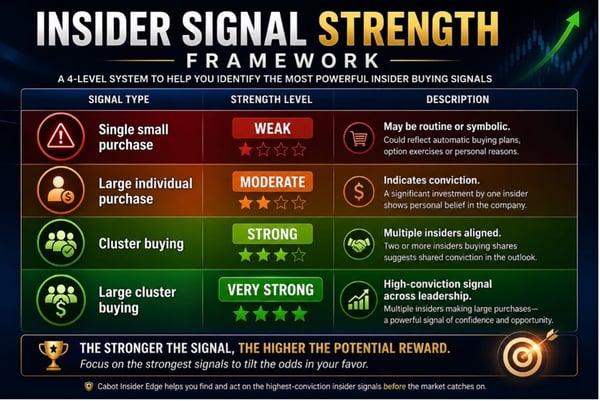
By now, you can probably see the opportunity.
The pattern is there.
The signals are there.
The logic is clear.
But there’s one obvious problem. Using this information in the real world isn’t easy. (If it was, everyone would do it.)
Because while insider activity is technically public it’s not presented in a way that’s simple, clear, or actionable.
It’s buried in regulatory filings. Scattered across thousands of companies. Mixed in with routine transactions, small purchases, and irrelevant data points.
Without a disciplined framework it’s almost impossible to tell the difference between a meaningful, high-conviction signal and noise that can lead you in the wrong direction.
That’s why, until now, most investors have either ignored insider buying altogether. Or tried to use it in a way that produces inconsistent results.
What’s been missing is a structured, repeatable approach.
A way to:
- Track insider activity across the market
- Filter out low-quality signals
- Focus only on the most meaningful buying
- And identify the moments when the odds are shifting in your favor
In other words a disciplined system that turns raw insider data into clear, actionable insight.
And that’s exactly what we’ve built.
That’s why we’re launching a brand-new advisory…

An investment research and advisory service built around a simple but powerful idea:
Help investors profit by following the real-money actions of company insiders, at the exact moments when opportunity is greatest.
Not after the headlines improve.
Not after analysts upgrade the stock.
Not after the move is already underway.
But during that critical window…
When prices are still depressed…
When sentiment is still negative…
And when insiders are quietly stepping in.
At its core, Cabot Insider Edge is designed to do one thing exceptionally well:
Identify high-conviction insider buying in out-of-favor stocks before the rest of the market catches on.
To do that effectively you need more than raw data.
Because as you’ve seen, insider filings by themselves are messy, inconsistent, and often misleading if taken at face value.
That’s why this is not a data service.
It’s not a feed of transactions.
It’s not a list of “recent insider trades.”
Instead it’s a disciplined, fully developed investment approach.
Every recommendation Cabot Insider Edge subscribers receive is built on three essential pillars:
Analysis.
We go beyond the surface-level filings to determine whether insider activity is truly meaningful. That means focusing on cluster buying, significant purchases, and the specific executives involved—while filtering out routine or low-value transactions.
Timing.
We don’t just identify insider buying—we place it in context. Is the stock under pressure? Is sentiment negative? Is the market mispricing the situation? This is where the Insider Timing Gap comes into play—helping you act during the window when probabilities begin to shift.
Discipline.
Not every insider signal is worth following. And not every opportunity should be acted on immediately. Cabot Insider Edge applies a consistent framework to decide when to move from “watch” to “buy”—and when to stay patient.
The result is a curated stream of ideas.
Not dozens of scattered signals but a focused set of high-quality opportunities where:
- Insiders are buying with conviction
- The stock is out of favor or under pressure
- And the setup suggests potential for a favorable risk/reward
In other words…
We do the hard work of tracking, filtering, and interpreting insider activity so you can focus on acting on the best opportunities.
Because the real edge here isn’t just knowing that insiders are buying.
It’s knowing:
Which signals matter…
why they matter…
and when to act on them.
That’s the mission of Cabot Insider Edge.
Of course, a strategy like this is only as strong as the person behind it.
Separating noise from real opportunity and knowing when to act requires more than just access to data.
It requires experience.
Judgment.
And a deep understanding of how markets—and the people inside them—actually work.
That’s why Cabot Insider Edge is led by …

Chief Analyst Michael Brush
Michael is not just another newsletter writer or market commentator.
He is a career financial journalist and investor analyst who has spent decades studying how professional investors think, how markets behave under pressure—and, critically, how insiders act when opportunity appears.
Over the course of his career, Michael has written extensively about the stock market for some of the most respected financial publications in the world.
Today, he writes a widely followed stock market column for MarketWatch, where he regularly analyzes trends, sentiment shifts, and—importantly—insider activity.
Previously he has covered markets, business, and economics for:
- The New York Times
- The Economist Group
- MSN Money
- Money magazine
This is important.
Because it means Michael hasn’t just participated in the market.
He has spent years observing it from the inside, interviewing top investors, analyzing their strategies, and identifying what actually works in real-world conditions.
That perspective shaped one of the defining elements of his approach: his focus on evidence over opinion.
In fact, Michael is the author of Lessons from the Front Line, a book that distills investing insights from leading professional money managers he encountered throughout his career.
In other words he didn’t just study theories.
He studied what successful investors actually do.
And one behavior kept showing up again and again: paying close attention to insider activity.
Because professional investors understand something most individuals overlook:
When insiders buy their own stock it’s often telling you something important.
Over time, Michael developed a particular expertise in this area.
Not just noticing insider buying… analyzing it. Breaking it down. Understanding which signals are meaningful and which are not.
For example, he emphasizes the importance of:
- Cluster buying—multiple insiders acting together
- Sizeable purchases—real money, not token buys
- Context—buying during weakness or negative sentiment
These are not casual observations.
They are the result of years of studying patterns across different companies, sectors, and market environments.
And that’s what makes his approach so valuable.
Because insider data, on its own, is overwhelming. Anyone can pull up a list of insider transactions. But very few people can interpret that information correctly.
Michael can.
He has spent years refining a framework for identifying which insider signals actually matter.
His work has earned him widespread recognition in the industry.
He has received multiple awards for excellence in journalism, including:
- The Best in Business Award from the Society of American Business Editors and Writers (SABEW)
- The National Magazine Award for General Excellence in New Media from the American Society of Magazine Editors
These are not minor accolades.
They reflect a career built on careful analysis, clear thinking, and a commitment to getting the story right.
Perhaps more important than awards is the role Michael has carved out for himself over time.
He is not a promoter. He is not a hype-driven commentator.
He is, at his core, a translator of complex market behavior into actionable insight.
A journalist who has spent decades asking: “What really works in investing—and why?”
Through that lens he has come to recognize the unique value of insider signals.
Michael’s has spent years doing what most investors don’t have the time or expertise to do:
- Tracking insider activity across the market…
- Filtering out the noise…
- Studying the patterns…
- And identifying the signals that consistently show up before meaningful moves.
In other words he has already done the hard part.
So instead of trying to interpret raw data on your own…
Or relying on gut instinct to decide when a stock is “cheap enough”…
You can leverage a process that has been refined over years of real-world observation. By a highly-experienced expert.
A process built on one simple principle: follow what insiders do—when it matters most.
And that’s exactly what Michael Brush is now bringing to Cabot Insider Edge.
Of course, even the best strategy—and the most experienced analyst—need to be backed by something equally important:
A trusted organization with a long track record of putting investors first.
Because in today’s financial publishing world there’s no shortage of flashy promises. No shortage of “can’t-miss” ideas. And no shortage of short-lived newsletters that appear one day and disappear the next.
That’s not what this is.

Actionable Investing Intelligence for 55+ years
Cabot Insider Edge is published by Cabot Wealth Network—one of the most established and respected independent investment research firms in the country.
Our story goes back more than half a century.
Cabot was founded in 1970 by Carlton Lutts.
At the time, the stock market was largely dominated by institutions—big firms with access to research, analysts, and insights that individual investors simply didn’t have.
Main Street investors were at a disadvantage.
Carlton saw that clearly.
And he set out to change it.
His mission was simple—but powerful: level the playing field.
Give individual investors access to the kind of research, insights, and disciplined strategies typically reserved for professionals.
So he began publishing the Cabot Market Letter…
Sharing his ideas on stock selection, market timing, and risk management.
And over time, something remarkable happened.
That small publication grew into a trusted resource for investors across the country—and eventually around the world.
Today, more than 50 years later, Cabot Wealth Network has helped hundreds of thousands of investors navigate markets, build portfolios, and pursue long-term wealth.
Through bull markets. Through bear markets.
Through periods of uncertainty, volatility, and change.
That kind of longevity doesn’t happen by accident.
It comes from a consistent philosophy.
At Cabot, the focus has never been on hype or sensational claims.
The focus has always been on:
- Proven investing strategies
- Careful analysis
- Disciplined decision-making
- And helping investors achieve above-average returns with below-average risk
That approach has led to some notable successes over the years.
Cabot analysts have identified major long-term winners early—including companies like Apple, Tesla and Nvidia.
But more important than any single stock is the process behind those recommendations.
A process grounded in research, patience, and a commitment to getting it right.
That commitment is reflected in Cabot’s core values:
- Honesty—because trust is everything in investing
- Education—because informed investors make better decisions
- Customer success—because your results are the ultimate measure of value
And just as important Cabot operates under a business model designed to align its interests with yours.
Unlike many firms in the financial world:
- Cabot accepts no fees to promote stocks
- Cabot accepts no fees to promote stocks
- No compensation from brokerages or outside companies
In fact the only source of revenue is subscription fees.
That means Cabot’s success depends entirely on one thing: providing value to subscribers.
If the research isn’t useful…
If the insights don’t help you make better decisions…
If the recommendations don’t stand up over time…
Subscribers leave.
It’s that simple.
And that’s not how a company stays in business for more than half a century.
Cabot’s only commitment is to serve the needs of individual investors like you.
Not institutions. Not advertisers. Not corporate partners.
Just you.
That independence is rare. And it matters.
Because it allows Cabot to take a long-term view. To focus on what works not what grabs headlines.
To avoid the noise, the hype, and the distractions that dominate so much of the financial media landscape.
And instead deliver clear, disciplined guidance grounded in real-world investing principles.

|
Founded |
1970 (55+ years ago!) |
|
Location |
Historic Salem, Massachusetts |
|
Focus |
Independent investment intelligence |
|
Model |
100% individual subscription revenue. No brokerage or advertising. |
|
Mission |
Help individual investors achieve investing success |
When you combine that foundation with the specific expertise of an expert analyst like Michael Brush…
And a strategy built around one of the most powerful signals in the market…
You get something very different from the typical newsletter.
You get a stable, credible, research-driven approach designed to help you make smarter decisions—year after year.
Not just chase the next idea…
But build a process you can rely on.
And that’s exactly what Cabot Insider Edge is built to deliver.
Now let’s get very specific about …
What you’ll receive as a Cabot Insider Edge subscriber
Cabot Insider Edge is a complete, working system, designed to help you identify, evaluate, and act on the most meaningful insider signals in the market.
Everything is built around one goal: to help you consistently align yourself with high-conviction insider buying—at the right time.
Here’s how that happens.
Monthly Issues: Your Core Research Engine
At the heart of Cabot Insider Edge are the monthly issues. This is where Michael Brush delivers his most important work—carefully researched, fully developed investment ideas based on insider activity.
Each issue includes:
New Recommendations: You’ll receive a focused selection of stocks where insiders are buying with conviction—especially in situations where the market is skeptical, negative, or simply not paying attention.
Insider Activity Breakdown: For every recommendation, you’ll see exactly what insiders are doing, why it matters, and how to interpret these signals—so over time, you build your own understanding of what “high-conviction” really looks like.
Clear Entry Strategy: This is critical. You won’t just be told what to buy—you’ll be guided on how to approach it. Because timing matters—and acting blindly defeats the purpose of the strategy.
Email Alerts: Stay Ahead of the Market
Insider opportunities don’t wait for a monthly publication cycle. That’s why you’ll also receive timely alerts when important developments occur.
Real-Time Insider Buying Signals: When Michael identifies a high-quality insider signal—especially a large or clustered purchase—you’ll be notified quickly.
Updates on Existing Positions: Markets evolve and so do individual stocks.
Model Portfolio: A Structured Approach
One of the biggest challenges investors face is not just finding ideas but managing them effectively. That’s why Cabot Insider Edge includes a model portfolio but around high-conviction insider signals combined with disciplined execution
Direct Access to Chief Analyst Michael Brush
This is another key advantage because even with clear recommendations, questions come up. As a subscriber, you’ll have access to Michael Brush for guidance and insight.
Putting It All Together
When you combine everything…
- Monthly deep-dive research
- Timely alerts
- A structured portfolio
- Direct analyst access
You get something far more powerful than a typical advisory.
You get a complete system for:
- Identifying meaningful insider signals
- Understanding what they mean
- And acting on them with discipline
Because the real value here isn’t just information.
It’s clarity.
Clarity about:
Which signals matter…
why they matter…
and what to do next.
And that’s what Cabot Insider Edge is designed to deliver—consistently.
When you subscribe to Cabot Insider Edge, you’re not just getting stock ideas…
You’re gaining access to a completely different way of seeing the market.
A way to cut through noise… avoid costly mistakes… and zero in on opportunities most investors miss.
Because once you understand how to interpret insider behavior you stop chasing headlines.
You stop reacting emotionally to price swings.
And you start focusing on what actually matters: the real-money decisions of the people who know these businesses best.
That’s where the edge is.
And that’s what Cabot Insider Edge is built to deliver.
Now let’s talk about what it takes to get access to all of this.
Because a service like Cabot Insider Edge, built on decades of research, guided by an experienced analyst, and backed by a disciplined system, is not something we offer casually.
In fact the regular price for this level of research is $697 per year.
That’s a fair price when you consider all that you’re getting…
- A proven framework for identifying high-conviction insider signals
- Ongoing research and expert recommendations
- Real-time alerts
- A structured portfolio approach
- Direct access to an experienced analyst
It’s the kind of insight that, in many cases, institutional investors pay far more to access.
But for this launch we want to make it as easy as possible for you to get started.
So for a limited time…
You can get a Charter Subscription to Cabot Insider Edge for just $347 per year – 50% OFF.
That’s a full $350 savings off the regular price.
Now, step back and think about that for a moment.
In the world of investing, what is the value of a single good idea?
A single well-timed entry?
A single position where the odds are meaningfully in your favor?
If just one recommendation leads to a solid gain it could cover the entire cost of your subscription, many times over.
And beyond that…
You’re not just paying for individual ideas.
You’re investing in a process.
A framework.
A way of thinking about the market that can serve you again and again.
That’s where the real value lies.
But this introductory Charter Price is not permanent. It’s part of our launch offer.
That means at some point the price will go back to the standard $697 per year.
And new subscribers will pay that higher rate.
So if you’re interested in applying this approach…
If you want to start aligning yourself with high-conviction insider signals…
If you’re ready to move into a more disciplined, evidence-based strategy…
Now is the time to act.
Because this is your opportunity to get started at a significant discount.
And begin using a strategy built around one of the most powerful—and underutilized—signals in the market.
Of course, even with everything you’ve seen so far…
I understand you might still be wondering: “What if this isn’t right for me?”
That’s completely fair.
Because the last thing you should ever feel when making an investment decision, especially about an advisory service, is pressure.
So here’s how we remove that concern entirely.
Try Cabot Insider Edge completely risk-free
100% Money-Back Guarantee
- ✓Go through the first issue.
- ✓Review the recommendations.
- ✓See how the insider signals are analyzed.
- ✓Watch how the alerts work.
- ✓Ask Michael Brush for answers to your questions.
- ✓Experience the process for yourself.
And then decide.
If at any point within your first 30 days you feel this isn’t delivering value…
If the research doesn’t meet your expectations…
Or if you simply decide it’s not a fit for your investing style…
Just let us know.
You’ll receive a 100% full refund—no questions asked.
No hoops. No complicated conditions. No hard feelings.
You’re not committing to a long-term obligation.
You’re simply giving yourself the opportunity to see if this approach makes sense for you.
At the end of the day, this all comes down to a simple choice.
You can continue investing the way most people do…
- ✕ Relying on headlines.
- ✕ Reacting to price moves.
- ✕ Trying to "feel" when a stock is cheap enough.
- ✕ Guessing when fear has gone too far.
And sometimes that will work. But often, it won’t.
Because the market doesn’t reward guesses.
It rewards positioning.
It rewards those who act before the story changes… not after.
That’s the transformation we’ve been talking about.
The shift from guessing to knowing.
Not knowing the future with certainty but knowing when the odds are beginning to shift.
Knowing when perception has drifted too far from reality.
Knowing when the people closest to the business—the executives and directors—are stepping in with real money.
That’s the insider edge.
You gain something even very powerful.
A way to identify opportunity before it becomes obvious.
A way to act during that quiet window…
When prices are still depressed…
When sentiment is still uncertain…
And when insiders are already positioning themselves for what comes next.
That’s where some of the best opportunities begin.
Now you have a way to approach the market with more clarity. More structure. And more confidence.
A way to align yourself with the people who already understand what’s happening inside these companies and are willing to act on it. With their own capital.
That’s what Cabot Insider Edge is designed to do.
To give you a repeatable process. A disciplined framework…
And a steady stream of high-quality opportunities grounded in real-world behavior—not speculation.
Right now, you have the chance to get started at a significant discount.
Test the service risk-free. See for yourself how this approach works in real time.
This opportunity won’t stay open forever.
So if you’re serious about improving your investing results. If you’re ready to move beyond guesswork. If you want to start making decisions based on evidence instead of emotion then now is the time to act.
Subscribe to Cabot Insider Edge below
And begin putting one of the market’s most powerful—and overlooked—signals to work for you.
Sincerely,
Ed Coburn
Chairman and CEO
Cabot Wealth Network


(Offers for new subscribers only) Prefer to order by phone? Call our customer service team at 1 (800) 326-8826 Monday–Friday from 8:30 a.m.–5:00 p.m. ET, or email us anytime at support@cabotwealth.com
P.S. You can get full access to Cabot Insider Edge—including monthly recommendations, real-time alerts, a structured model portfolio, and direct insight from Michael Brush—for just $347 per year.
That’s a full 50% discount off the regular $697 price.
And you’re protected by a 30-day 100% money-back guarantee, so you can try it with zero risk.
But this is a limited-time Charter offer. Now is the time to act.
The next insider signal could already be forming.
Right now…
In a stock that’s out of favor…
In a company the market is overlooking…
In a situation where perception and reality are starting to diverge.
Will you see it in time to act or will you hear about it later, after the move has already begun?
Join Cabot Insider Edge today and put yourself in position to find out.



Our Guarantee
We strive to constantly earn your business every day. This approach has helped us become one of the highest rated and longest-established financial publishers in the industry.
We pride ourselves on our transparency and the quality of our investment services.
If on the rare chance you aren’t satisfied, simply email me within the first 30 days of your annual subscription for a full, no-questions-asked refund.
If you choose the annual plan, you’ll also get our 30-day 100% money-back guarantee after the trial converts. That’s 60 days to kick the tires, paper trade, or do whatever you like so you can be absolutely sure this service is right for you.